Fixing Data Silos: Why Your Startup's Marketing Needs a Unified BigQuery Data Strategy
Stop wasting seed funding on gut feelings and vanity metrics that derail growth. Discover how a BigQuery-centered strategy and proprietary AI can unify your tech stack, fix attribution, and turn raw data into a scalable revenue engine.
For most high-growth startups, the journey from seed to Series B is marked by rapid experimentation and a 'move fast and break things' mentality. However, as these organizations transition into the scaling phase, they inevitably hit a formidable wall: the Marketing Analytics Translation Gap. This gap represents the chasm between the massive volume of data being collected and the actual strategic insights required to drive profitable growth. For many small-to-mid-sized businesses (SMBs), the tools meant to facilitate growth often become the very obstacles holding them back.
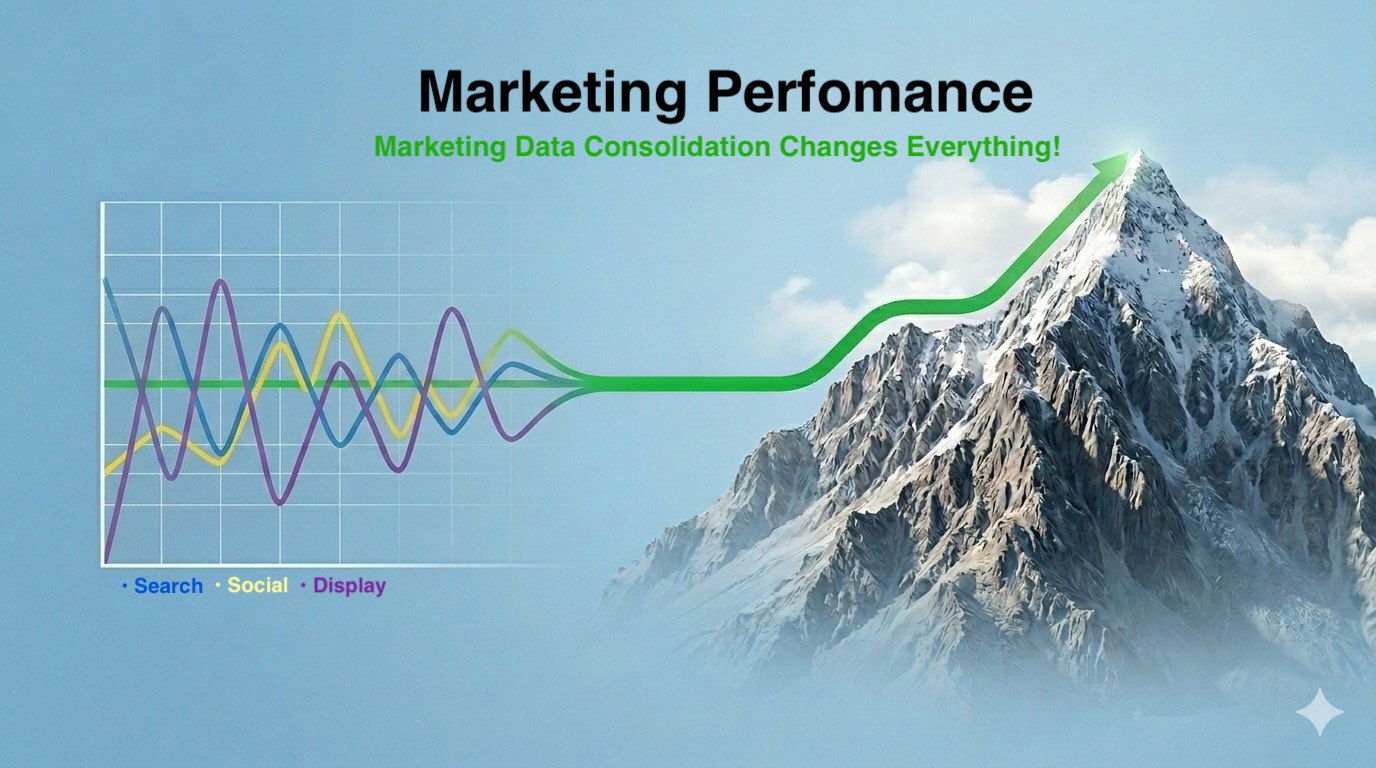
The Four Hurdles of Modern Marketing Analytics
Before a startup can implement a solution, it must first diagnose the symptoms of its inefficiency. Through our work as data architects, we have identified four primary hurdles that consistently derail scaling efforts.
1. Data Fragmentation and Silos: Most startups operate on a 'best-of-breed' marketing tech stack, using Google Ads / Bing Ads for search traffic, Meta Ads (Facebook / Instagram) for social advertising, separate DSPs or dispersed display / video ads efforts, and HubSpot for lead management. While these advertising tools are powerful in isolation and give solid AI recommendations for their disparate channel performances, they don't conglomerate all ads sources and create unique recommendations to improve overall ads performance. This fragmentation makes a unified customer journey impossible to visualize and makes even basic decisions like allotting ad budgets between various tactics inefficient. When data is trapped in silos, marketers cannot see how a Facebook ad from 27-days ago contributed to a closed-won deal today. Consequently, leadership often cuts budget on channels that drive vital 'assisted conversions' simply because they do not appear in a last-click attribution model.
2. The Vanity Metrics Trap: It is estimated that roughly 73% of businesses fail to drive meaningful results because they focus on vanity metrics—clicks, likes, and impressions—instead of revenue-generating activities. Startups often optimize for engagement levels that do not impact the bottom line. Without a clear link between marketing activity and LTV (Lifetime Value), teams end up running on a treadmill of high activity but low financial impact.
3. Skill Shortages and Resource Constraints: Google’s own research indicates that 26% of marketers cite a lack of analytics talent as a top challenge. Lean teams often purchase sophisticated tools that ultimately become 'expensive shelf-ware.' Without the in-house expertise to configure advanced tracking or interpret complex datasets, marketers default to intuition and 'gut feelings' rather than hard data.
4. Measurement and Attribution Complexity: In a multitudinous stack of ad platforms and siloed data sets it's inevitable to end up wildly inaccurate Customer Acquisition Cost (CAC) and Return on Ad Spend (ROAS) calculations. If your data is 30% off, your scaling decisions will be 100% wrong. While options do exist in many Startup tech stacks to conglomerate ads data and remove the issues from siloed performance decisions making those options typically cost thousands of dollars per month (eg Hubspot's Data Hub & Marketing Hub costs). And in the long-term those implementations lead towards black-box AI guidance that is not specific nor proprietary a given business.
The Strategic Fix: The BigQuery Advantage
To overcome these hurdles, startups must evolve their marketing data maturity (as well as their overall business data maturity). The solution lies in Google BigQuery, a serverless, highly scalable cloud data warehouse. By ingesting marketing data from every source into BigQuery, businesses can finally close the translation gap.
BigQuery acts as a Single Source of Truth. By merging raw ad platform data and web event streams from various ad platforms, businesses can create a holistic view of the advertising performance in customer acquisition efforts. This centralization allows for custom attribution modeling that goes far beyond the basic options provided by GA4 or Facebook Ads. It also easy to add in CRM data to BigQuery. From there, you can finally see the true path to conversion, accounting for every touchpoint across the funnel.
Furthermore, centralizing data in BigQuery unlocks the potential for Advanced AI Modeling. Rather than just looking at 'what happened' in the past (descriptive analytics), startups can begin to predict 'what will happen' (predictive analytics). This includes churn prediction, lead scoring, and automated budget allocation across the most efficient advertising channels (including offline channels like direct mail or mass media).
The Final Step: Proprietary AI and LLM Analytics
As startups reach the peak of data maturity, the focus shifts toward Large Language Model (LLM) Analytics and proprietary AI setups. Imagine a system where a marketing manager can ask a private AI bot, 'Which campaigns are driving the highest LTV customers from the Northeast region?' and receive a data-backed answer in seconds. By layering an LLM over your BigQuery data warehouse, you democratize data access across the entire organization, removing the bottleneck of technical reporting and allowing for real-time strategic pivots.
Scaling a startup is difficult, but doing it without a unified data strategy is nearly impossible. Moving to a centralized ingestion model is no longer a luxury for the enterprise—it is a requirement for any SMB that intends to compete in an AI-driven market.
Mountainous Marketing is available to advise on data ingestion capabilities, marketing strategies, tech implementations and analytic designs. Contact Us
Contact Mountainous Marketing: 9705861133 · Colorado