Is Your Site Ready for AI? A Cloudflare Guide to Winning the New Search Frontier
Stop guessing if AI agents can find your content. Learn how to balance SEO, GEO, and AEO using Cloudflare’s new scanner to audit your 'Agent Readiness' and get custom AI prompts to fix technical issues instantly.
The digital marketing world is currently witnessing a tectonic shift in how information is discovered, processed, and delivered. For decades, the industry lived and breathed by the rules of traditional Search Engine Optimization (SEO). However, we have entered a new era where Search Engine Optimization is being augmented—and in some cases, replaced—by Generative Engine Optimization (GEO) and Answer Engine Optimization (AEO). Navigating this tripartite landscape requires a nuanced understanding of how search engines, large language models (LLMs), and AI agents interact with your content. The goal is no longer just to rank on page one of Google; the goal is to be a respected source of truth for the AI agents that are increasingly making decisions on behalf of users.
The Myth of 'SEO is Dead' Proclamations
Every few years, a new technology emerges that leads pundits to declare the death of SEO. Whether it was the rise of social media, the shift to mobile, or the dominance of video content, SEO has consistently proven to be resilient. Today, the narrative is that AI and generative search will kill organic traffic. This is a fundamental misunderstanding of the ecosystem. While the presentation of search results is changing, the underlying need for high-quality, authoritative content has never been higher. AI agents like ChatGPT, Claude, and Gemini are not generating information out of thin air; they are trained on and retrieve data from the open web. This means that the core tenets of E-E-A-T (Experience, Expertise, Authoritativeness, and Trustworthiness) remain the foundation of all digital visibility.
Traditional SEO focuses on keywords and backlinks to drive traffic to a website. AEO focuses on providing direct, concise answers to specific queries, often for voice search or featured snippets. GEO, the newest arrival, focuses on ensuring your brand and content are cited accurately within the synthetic responses generated by LLMs. To win in this environment, you must realize that these are not competing strategies but rather three facets of the same goal: being the most helpful resource for a user’s intent. If your content is truly authoritative and provides unique, human-centric insights that AI cannot easily replicate, you will remain relevant regardless of the platform.
The New Technical Handshake
In the traditional SEO world, technical optimization has often focused on site speed, mobile-friendliness, and simple XML sitemaps. While these still matter, the 'Technical Handshake' has evolved. We are now optimizing for a new class of visitors: AI agents. These agents (such as GPTBot, CCBot, or Claude-Bot) have different crawling patterns and requirements than traditional search spiders. If your site’s architecture or robots.txt file is not configured correctly, you might be accidentally blocking the very engines that are now responsible for a growing percentage of brand discovery. Technical SEO now demands a proactive approach to managing how AI agents perceive your site’s structure.
Structured data and Schema markup have also transitioned from 'nice-to-have' extras to absolute necessities. Schema provides the semantic context that helps AI agents understand the relationship between your products, your authors, and your claims. Without robust Schema, an LLM might misinterpret your data or fail to attribute a quote to your brand. We are seeing a shift where the metadata of a page is just as important as the visible copy. By providing a clear, machine-readable map of your content, you make it significantly easier for generative engines to pull your brand into their responses as a cited authority.
Introducing the Cloudflare 'Is It Agent Ready?' Scanner
As the complexity of technical optimization increases, marketers need tools that can bridge the gap between human strategy and machine requirements. This is where Cloudflare has stepped in with a revolutionary free tool. Pro-Tip: You can immediately audit your website’s readiness for the AI era by using Cloudflare's Is It Agent Ready? scanner. This tool provides a comprehensive overview of how various AI agents see your site, identifying potential blockers that could be hindering your visibility in GEO and AEO results.
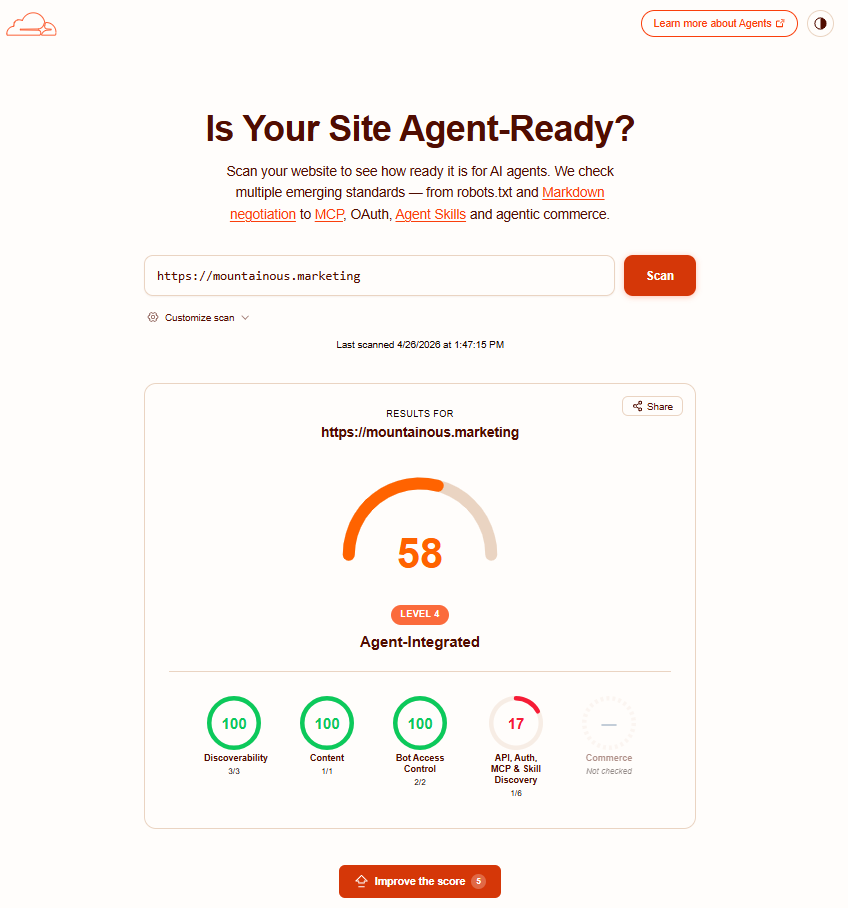
The scanner analyzes several critical factors, including whether your robots.txt allows for the appropriate bots, whether your security settings (like WAF or bot management) are inadvertently blocking legitimate AI crawlers, and how well your content is structured for ingestion. In an era where being 'AI-friendly' is the new 'mobile-friendly,' this tool is an essential part of any modern marketing audit. It moves beyond generic SEO scores to give you a specific 'Agent Readiness' profile, which is crucial for staying ahead of the competition.
The 'Killer Feature' of Scans: Custom AI Prompts
The most impressive aspect of Cloudflare’s scanner isn't just the diagnostic data; it’s what it allows you to do with that data. The tool features a 'Killer Feature' that provides direct, copy-and-paste AI prompts tailored to the specific issues identified on your site. If the scanner detects that your structured data is lacking or that your robots.txt is misconfigured it doesn't just tell you there is a problem. It gives you a prompt that you can paste into an AI Agent code consultant (eg Gemini or Claude) to generate the exact code or content fixes needed for your website.
For example, if your site lacks specific HTTP Link header to enhance a website's agent discoverability—which is vital for AEO—the tool provides a prompt like:
Goal: Include Link response headers for agent discovery (RFC 8288)

Issue: No Link headers found on homepage

Fix: Add Link response headers to your homepage that point agents to useful resources. For example: Link: </.well-known/api-catalog>; rel="api-catalog" to advertise your API catalog, or Link: </docs/api>; rel="service-doc" for API documentation. See RFC 8288 for the Link header format and IANA Link Relations for registered relation types.

Skill: https://isitagentready.com/.well-known/agent-skills/link-headers/SKILL.md
Docs: https://www.rfc-editor.org/rfc/rfc8288, https://www.rfc-editor.org/rfc/rfc9727#section-3
This allows even non-technical marketers to implement sophisticated technical fixes in minutes. You can use these AI prompts to interact with Claude or Gemini to refine your content interactions with Agents, ensuring it meets the specific heuristic requirements these engines use to rank authoritative sources. This creates a virtuous cycle: you use AI to optimize your site for other AI, ensuring total alignment between your content and the agents that crawl it.
Simultaneous Optimization: Your Action Plan
To successfully optimize for SEO, GEO, and AEO simultaneously, you need a multi-layered approach. First, continue your traditional SEO efforts by creating high-value content that answers real human needs. Second, prioritize AEO by structuring your content with clear headings and concise summaries that can be easily pulled into featured snippets. Third, tackle GEO by ensuring your technical foundation is open to AI agents and that your brand’s citations are consistent across the web.
- Step 1: Run your site through the https://isitagentready.com scanner to identify immediate technical blockers.
- Step 2: Utilize the provided AI prompts to generate the necessary robots.txt and Schema.org updates.
- Step 3: Audit your top-performing pages to ensure they have a 'Direct Answer' section for AEO.
- Step 4: Monitor your brand mentions in LLM outputs to track your GEO performance over time.
The evolution of search is not a threat; it is an opportunity for those willing to adapt. By embracing the technical requirements of AI agents and maintaining a commitment to high-quality, human-centric content, you can ensure your brand remains at the forefront of discovery. Don't wait for your traffic to drop to realize the world has changed. Scan your site today, use the prompts provided, and take control of your visibility in the age of AI.
Mountainous Marketing is available to advise on marketing strategies, tech implementations and analytic designs. Contact Us
Contact Mountainous Marketing: 9705861133 · Colorado